 Fat Gone
 Calories burned, estimated for your day.
How much does a brisk walk, a bike ride or housework contribute? Choose an activity and enter your details to get a personal estimate using the same method and activity values as Fat Gone.
Calculate your activity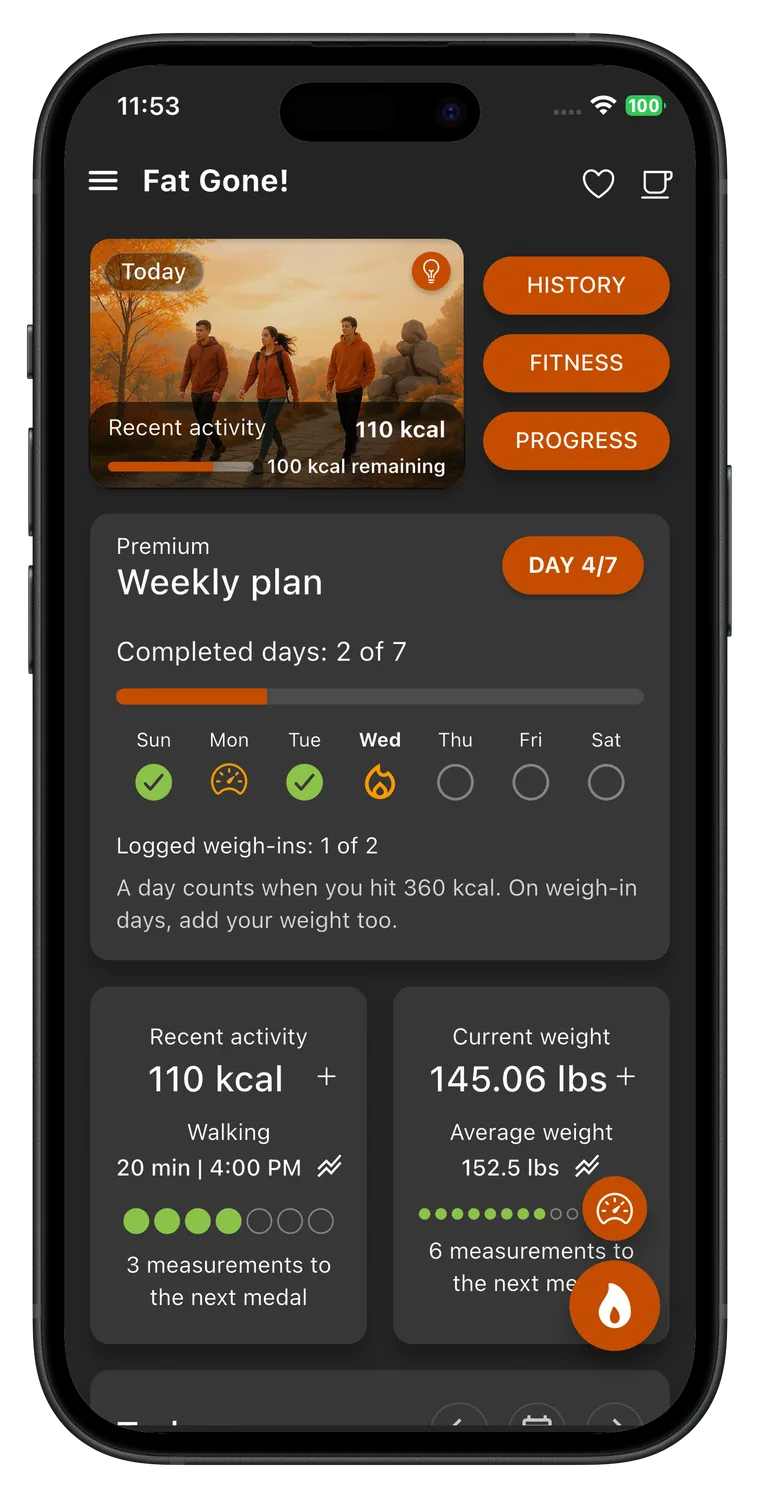
Estimate calories burned
Choose an activity, adjust the details, and get a personal estimate. Your entries stay in this browser.
Activity calories here include the energy your body would use at rest during the same time. They are not “extra” calories above rest.
Keep an activity record in Fat Gone
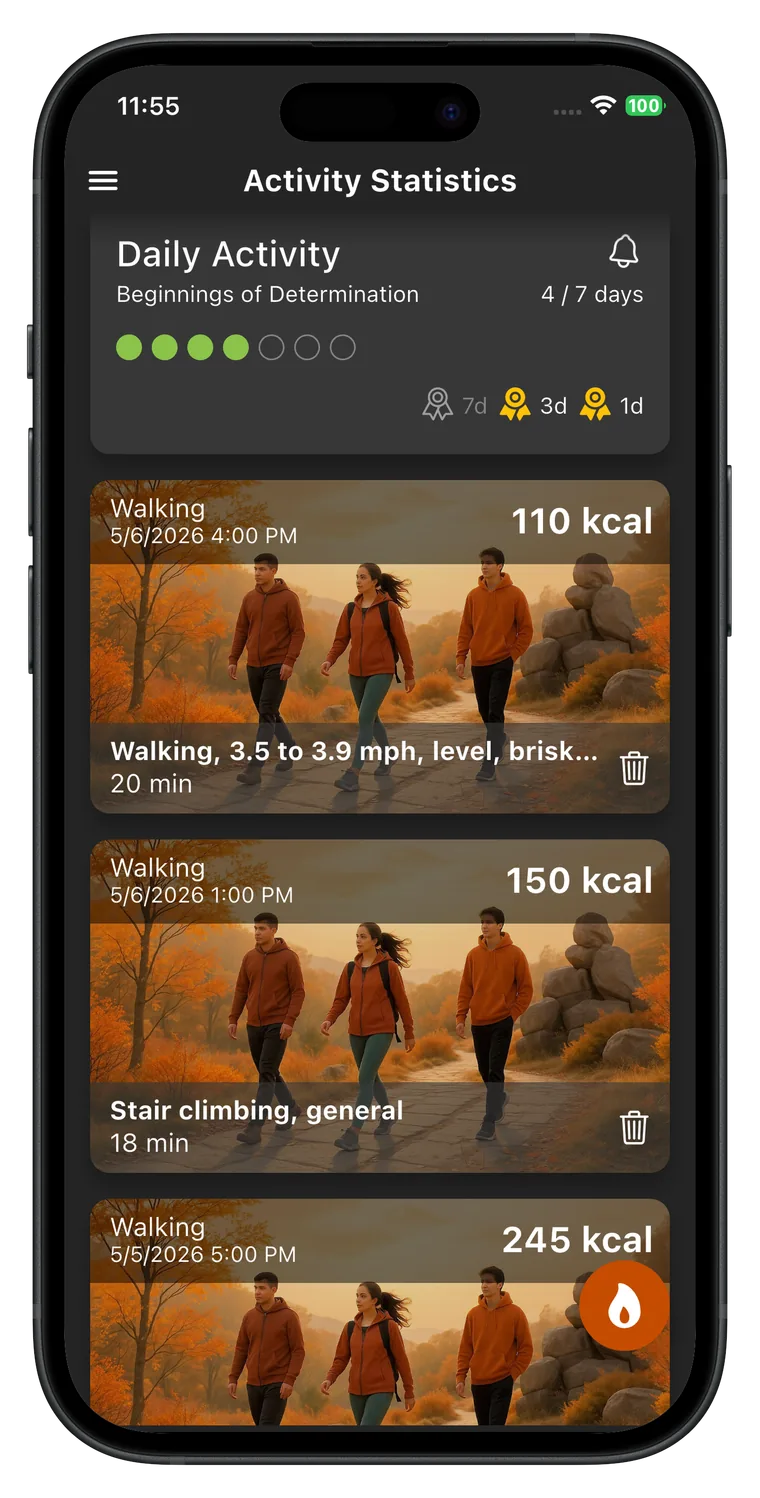
Fat Gone lets you log activities, follow a personalized calorie-burn goal, and review weight and progress over time. Choose from the full activity catalog when your day includes more than a standard workout.


How this estimate works
Fat Gone stores an intensity value, called a MET, for each activity. One MET represents approximate resting energy use; a higher MET indicates more energy used during the same time. The app estimates basal metabolic rate (BMR) from age, height and weight, then calculates activity energy as BMR ÷ 24 × MET × hours. The calculator above follows that default app method. The app also offers a Harris–Benedict BMR option, so your in-app figure can differ if you choose it.
The default BMR estimate uses the Mifflin–St Jeor equation: 10 × weight in kg + 6.25 × height in cm − 5 × age in years, then +5 or −161 according to the selected formula parameter. It is an estimate of energy use at rest, not a measured metabolic rate. Fat Gone rounds BMR and then the final calorie result, so small differences from other calculators are expected.
For example, a 35-year-old person using the female parameter at 75 kg and 170 cm has an estimated BMR of 1,477 kcal per day. Thirty minutes of brisk walking at 4.8 MET is about 148 kcal by the app’s method. Walking speed, hills, load and individual physiology can change actual expenditure. Treat the figure as a planning aid, not a precise measurement or a promise of weight loss.
Everyday activity intensity guide
The choices below come from the activity catalog bundled with the Fat Gone Flutter app. Pick the description closest to what you actually did. A quick walk and a slow stroll should not share a calorie estimate, even when both last 30 minutes.
| Activity | MET | 30-minute estimate |
|---|---|---|
| Slow walk (2.0–2.4 mph) | 2.8 | 86 kcal |
| Moderate walk (2.8–3.4 mph) | 3.8 | 117 kcal |
| Brisk walk (3.5–3.9 mph) | 4.8 | 148 kcal |
| Easy cycling | 4.3 | 132 kcal |
| Moderate cycling | 7 | 215 kcal |
| Vacuuming | 3 | 92 kcal |
| Raking leaves | 4 | 123 kcal |
| Running around 5 mph | 8.5 | 262 kcal |
Walking
A moderate walk on level ground is 3.8 MET in the app catalog, while brisk walking at 3.5–3.9 mph is 4.8 MET. If your route has slopes or you carry a load, choose a more specific activity in the app. The time actually spent moving matters more than the distance alone in this calculator.
Cycling and running
Easy self-selected cycling is 4.3 MET; moderate cycling is 7.0 MET. Running around 5 mph is 8.5 MET. Conditions such as wind, gradient and stops can make a real ride or run differ substantially from these broad categories.
Housework and gardening
Vacuuming at moderate effort is 3.0 MET, and raking leaves at moderate effort is 4.0 MET. These activities count as movement, but time and effort vary a lot. Estimate only the minutes spent actively doing the task, rather than the whole time set aside for it.
What the result can and cannot tell you
This tool estimates gross energy expenditure, which includes resting energy use during the activity. To compare a session with doing nothing for the same duration, subtract the estimated resting portion (BMR ÷ 24 × hours). Neither number is a direct measurement. MET values describe typical activity intensity, while the BMR formula predicts resting expenditure from population data.
Do not convert a single activity estimate directly into expected weight loss. Body-weight change depends on overall intake, expenditure and many other factors over time. The useful habit is to log comparable activities consistently and look for a sustainable pattern. If you are managing a health condition, pregnant, or recovering from an injury, use advice from a qualified clinician when planning activity.
Sources and product method
The selected codes and MET values are from the Fat Gone app’s bundled activity data. The app cites the Compendium of Physical Activities for activity intensity. Its default BMR calculation follows the Mifflin–St Jeor equation. Values are reviewed against the app source when this page changes; the live app remains the source of truth.
Prepared by CreamSoft, maker of Fat Gone. Activity values and method reviewed:
Choose the movement in your day
Walking calories
Choose a slow, moderate, brisk or very brisk walk. Enter your walking time and personal details to estimate the energy used, with the same activity values and default calculation as Fat Gone.
Open the calculatorCycling calories
Estimate the energy used during a bike ride from moving time and easy, moderate or vigorous effort. This tool uses the same three cycling entries and default calculation as the Fat Gone app.
Open the calculatorHousework calories
Vacuuming, mopping, sweeping and carrying groceries all involve movement. Choose the task and count the minutes you actively spent doing it to get an estimate using Fat Gone’s activity data.
Open the calculatorTake the estimate into your daily plan.
Fat Gone lets you log activities, follow a personalized calorie-burn goal, and review weight and progress over time. Choose from the full activity catalog when your day includes more than a standard workout.
Activity guides
Practical guides to everyday movement, weekly planning and calorie estimates. Understand the numbers, then choose an approach you can repeat.
How to be more active without a gym
Build everyday movement around walks, errands and household tasks. A practical guide to finding time, tracking activity and avoiding double counting.
Read the guideHow to build a weekly activity plan you can keep
Create a weekly movement plan with realistic time slots, fallback options and a simple review. Learn how to record completed activity in Fat Gone.
Read the guideActive vs total calories: what is the difference?
Understand active, resting and total calories with a worked walking example. Learn what Fat Gone estimates and how to avoid counting resting energy twice.
Read the guideWhy your watch and calorie calculator disagree
Compare watch and calculator calories fairly. Check active versus total energy, timing, activity choice, profile details and the method behind each estimate.
Read the guide