 Fat Gone
Start with the day you already have
Look at yesterday’s schedule before designing a new routine. Where were you sitting, waiting, commuting or doing household work? Choose one moment you can control: a short walk after lunch, a nearby errand on foot, or a break between tasks. A specific time and place are easier to act on than an open-ended intention to burn more calories.
Keep the first change modest enough to repeat on an ordinary busy day. You do not need to replace every journey or reorganize the whole week. Test one change, notice what gets in the way, and adjust the opportunity before adding more.
Choose movement with a clear beginning and end
A walk to a shop, ten minutes of vacuuming or a planned bike ride has a duration you can describe. These are easier to record consistently than a vague estimate of being busy all afternoon. Choose the activity you actually performed and count the time spent moving, excluding a seated break or a long stop.
For mixed tasks, record the distinct moving periods separately. If you swept for ten minutes and then vacuumed for twenty, that is not thirty minutes at the highest intensity. Household movement is real activity, but the entire time at home is not one continuous exercise session.
Give each opportunity a fallback
Write a simple main option and an alternative. A lunch walk may become a shorter walk near home if a meeting overruns. A ride may become an indoor household task if the route is unsuitable. The fallback should solve the scheduling problem, not recreate the original calorie number at any cost.
Treat these as planning examples rather than equivalent workouts. Different activities have different intensities and purposes. Pick something compatible with your ability and surroundings; a task that is painful or unsafe is not a useful substitute merely because it produces a larger estimate.
Keep minutes and calorie estimates separate
Minutes tell you what you made time for. Calories add an estimate that depends on the selected activity and your profile. With the website’s example profile, thirty minutes of brisk walking is about 148 kcal gross. That includes energy the model assigns to resting during the same period; it is not 148 extra calories above rest.
Use a calculator to compare time and pace, not to decide that the biggest number is the best activity. Consistent recording can reveal whether your routine is repeatable. A missed walk cannot be repaired by entering a harder activity you did not do.
Avoid recording the same movement twice
If your errand is already included in a recorded walk, do not add it again as a separate walking session. Similarly, a watch’s full-day energy total can already include that journey. Adding every manually calculated session on top of a daily total can duplicate activity and resting energy.
Keep a simple record of the period covered by each entry. When comparing tools, check whether you are looking at one session or a whole day, and whether the number is active or total energy. You can be consistent without making the different methods agree exactly.
Review what was practical, then change one thing
After a week, look for the opportunity you completed most often. Was its timing convenient? Was the route available? Did the duration feel manageable? Keep the useful part and change one obstacle. A shorter reliable opportunity may be a better starting point than an ambitious session repeatedly postponed.
Choose activities that suit your ability. If a health condition affects movement, obtain individualized advice before changing the type or amount of activity. Calorie estimates do not establish whether an activity is appropriate for you.
Examples to adapt to your own day
| Opportunity | Specific action | What to record |
|---|---|---|
| After lunch | Walk a familiar route | Actual moving minutes and pace |
| An errand | Walk part of the journey | The walking segment, excluding stops |
| Household work | Separate sweeping and vacuuming | Time for each task |
| A busy day | Use a shorter fallback | What you completed, not the original plan |
Your next steps
- Choose one opportunity in tomorrow’s schedule.
- Name the activity and a realistic duration.
- Prepare a shorter fallback that suits your circumstances.
- Record completed movement once, with actual time.
- Review the routine after a week before adding more.
Put the idea into practice
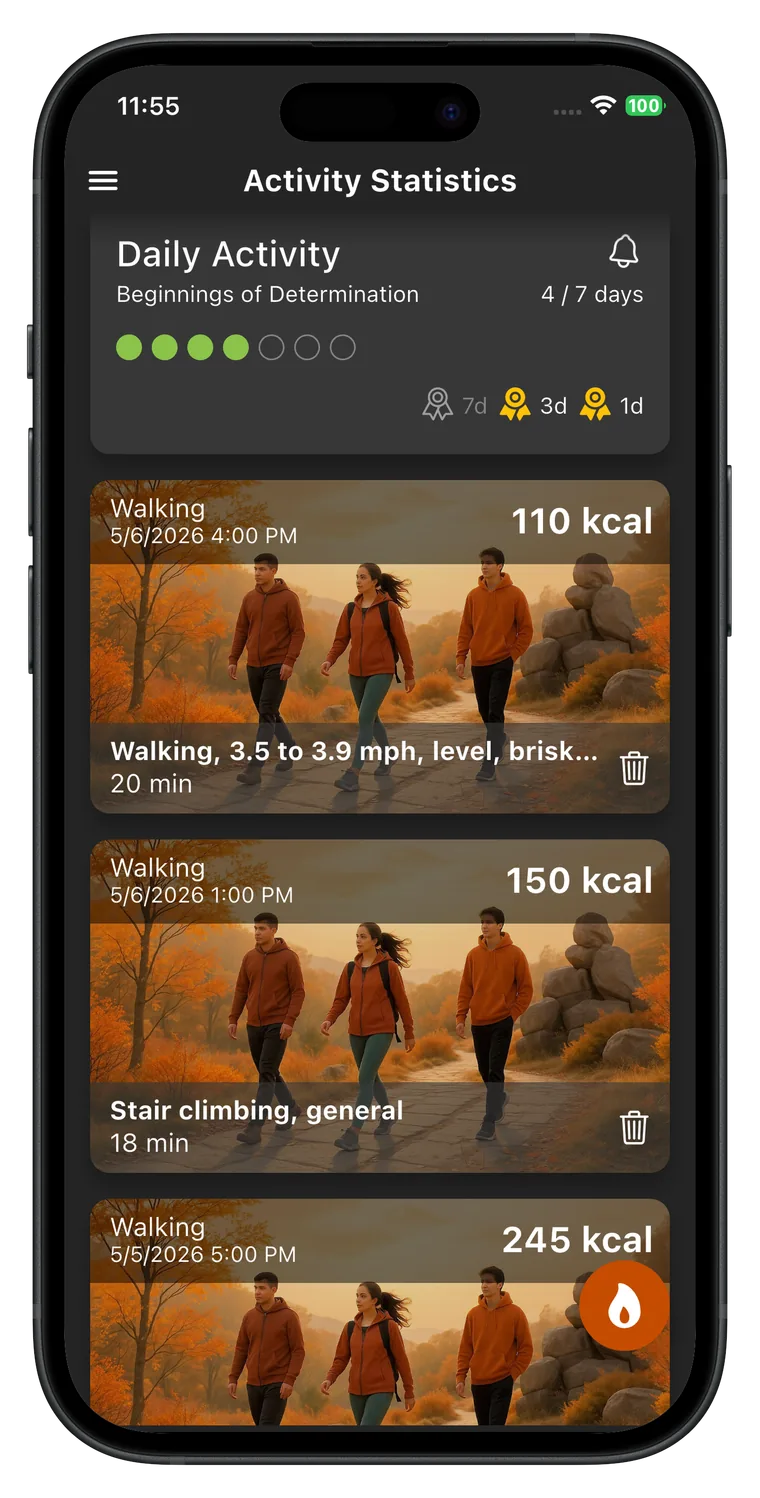
Fat Gone lets you choose activities and record their duration alongside your calorie goal and weight progress. Start with the movement you actually completed. The walking calculator can help compare pace and time before you record a routine; the app keeps the ongoing record.


Sources and editorial scope
These guides explain activity planning and the app’s estimates. CreamSoft checked product details against the app source on 1 October 2026. They are not a medical review or an individual exercise prescription. Linked research and official guidance provide context; examples are illustrative.